

William Glackens
American • 1870–1938 • Ashcan School
William James Glackens was born in Philadelphia on March 13, 1870, and became one of the central figures in early 20th-century American art. Trained at the Pennsylvania Academy of the Fine Arts, he began his career as an illustrator for Philadelphia newspapers and later for major New York publications. This early work honed his eye for everyday narratives and laid the foundation for his lifelong interest in scenes of modern urban life.
In the mid-1890s, Glackens joined a circle of young artists around Robert Henri, a group committed to depicting contemporary experience rather than academic idealization. This cohort, later known as The Eight, sparked the rise of the Ashcan School, a movement that shifted American art toward realism, vitality, and unvarnished depictions of daily life in New York. Glackens’ paintings from this period, with their dark tonalities and energetic brushwork, captured the cafés, parks, and neighborhoods of a rapidly changing city.
After traveling to Europe and studying works by Manet, Renoir, and the Impressionists, Glackens gradually moved toward a brighter palette and more fluid, color-driven style. His portraits, still lifes, and leisure scenes from the 1910s and 1920s show the influence of French modernism while maintaining the warmth and naturalism that defined his work. His paintings are admired for their rich color, lively brushwork, and joyful depictions of everyday life.
Glackens played a significant role in shaping American art collections as well. In 1912, he traveled to Paris at the request of his former schoolmate Albert C. Barnes, selecting the European modern paintings that became the foundation of the Barnes Foundation. Throughout his career, he continued to advise on modern acquisitions, helping introduce American audiences to European avant-garde art.
A respected figure in the New York art world, Glackens served as the first president of the Society of Independent Artists in 1916 and exhibited widely throughout his life. He died on May 22, 1938, in Westport, Connecticut. Today, his work is represented in major museum collections, including the Barnes Foundation, the Brooklyn Museum, the Art Institute of Chicago, the Phillips Collection, and NSU Art Museum Fort Lauderdale, which holds the world’s largest archive of his paintings.
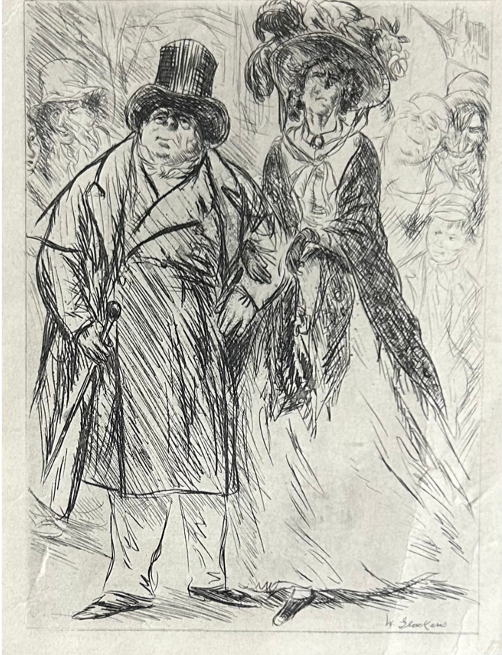
“Monsieur et Madame Mollet”