

Walter Crane
English • 1845 – 1915
Walter Crane was born in Liverpool on August 15, 1845, and became one of the most influential illustrators and decorative artists of the late 19th century. The son of portrait painter Thomas Crane, he grew up immersed in art and began decorating books with watercolor drawings at a young age. Crane apprenticed under the engraver William James Linton, whose technical mastery and socialist ideals shaped Crane’s artistic and political outlook for life.
In the 1860s, Crane began his professional career designing book covers and soon became a leading illustrator for Edmund Evans, the foremost color woodblock printer of the Victorian era. Through his imaginative designs for nursery rhymes, fairy tales, and the celebrated series of “Toy Books,” Crane became the most recognized children’s book illustrator of his generation. His work from this period reveals the influence of Japanese woodblock prints, the Pre-Raphaelites, and the emerging Arts and Crafts movement, with flat decorative compositions, rich color, and an emphasis on unified book design.
Crane was also an important figure in British social and political art. Deeply committed to socialist ideals, he created posters, pamphlets, political cartoons, and allegorical illustrations that supported labor movements and social reform. His major artistic achievement of the 1890s was his lavishly illustrated edition of Edmund Spenser’s The Faerie Queene (1894–1897), widely regarded as one of the finest works of the Arts and Crafts era. Its intricate borders, calligraphy, and medieval-inspired imagery reflect his belief in the unity of art, craft, and design.
Alongside his illustration work, Crane wrote influential books on art and design, including Of the Decorative Illustration of Books Old and New (1896) and An Artist’s Reminiscences (1907). His decorative style and socialist philosophy had a lasting impact in Britain and across Europe, particularly in Germany, where his work was highly admired.
Walter Crane died on March 14, 1915, in Horsham, England, leaving behind a legacy that shaped the development of modern illustration, book design, and political art.
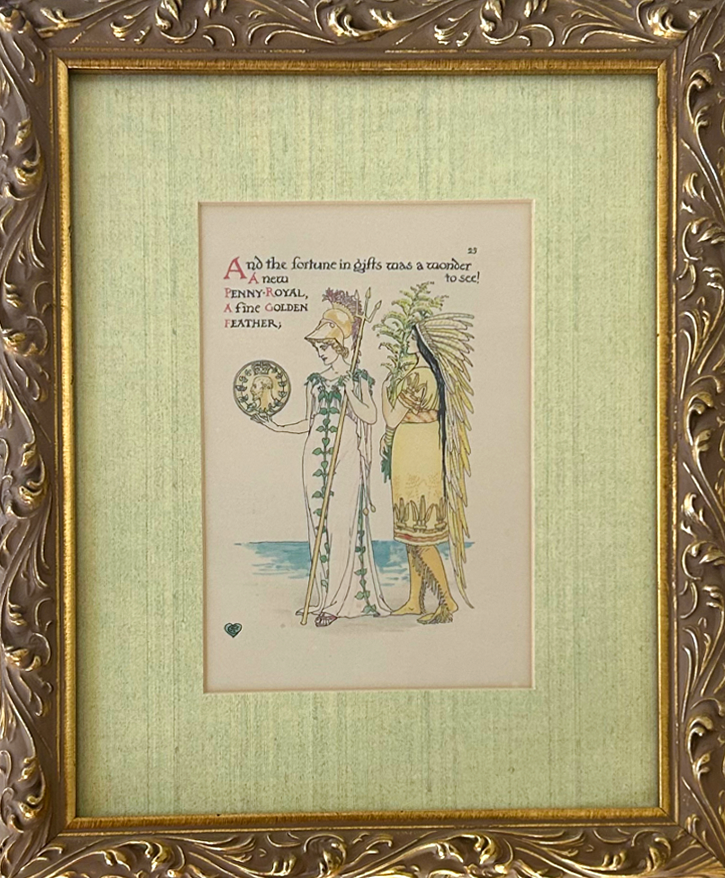
“Penny Royal”